


Swiss Wood:
More than just a label
CUBORO doesn’t start with the marble run—it starts with wood. After all, how well children build, experiment, and make progress depends on how reliably the material performs.

Why We Use Swiss Wood
When children build with CUBORO , it’s not just about shapes and paths.
It’s about making things work.
The marble has to roll.
The build should be stable.
The child should be able to keep building.
That is exactly why CUBORO starts with the material.
CUBORO elements are made of solid beech wood, which directly influences how children play with them:
- The marble runs smoothly through the tracks
- The elements are stable and shift very little
- Children can correct and improve their own track
If something doesn't work, it's not the material's fault—
— but rather a problem that becomes a solvable task.
This is exactly how those moments arise when children:
build, experiment, adapt, and think creatively.
To ensure this works reliably, we rely on wood from Switzerland.
The regional origin ensures short transport distances and precise craftsmanship—from the forest to the finished element.
This not only keeps transport distances short and minimizes the environmental impact,
but also ensures that expertise, attention to detail, and quality remain where the material is produced.

Reliable, transparent, responsible
We use wood bearing the "Swiss Wood" label.
This means:
- The wood is certified as originating from Switzerland
- The origin is transparent and verified
- Data processing is carried out in accordance with clear legal requirements
Switzerland has one of the strictest forest laws in the world:
- Only as much wood is used as can regrow
- Every use is regulated and monitored
- Clear-cutting is not permitted
Here, sustainability isn't just a promise—it's the foundation.
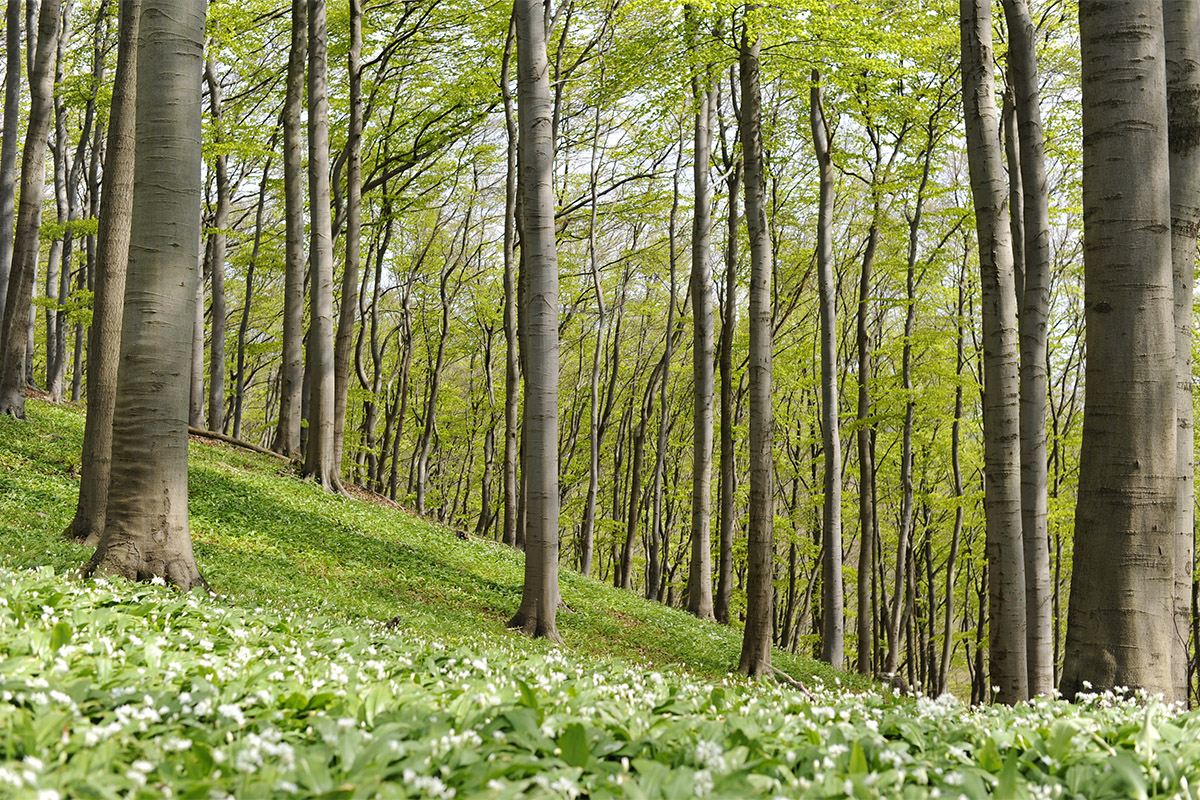
The Mother of the Forest
The beech (Fagus sylvatica), also known as the European beech, is the star of the Swiss forest: about 19% of all trees are beeches. It grows in deciduous and mixed forests up to an altitude of 1,400 meters and can reach a height of up to 30 meters. Without us humans, it would likely be the undisputed number one in the forest, as it is considered a particularly competitive tree species in Central Europe.
Under natural conditions, without human intervention such as forestry, clearing, or selective tree species choice, it would displace many other tree species in large parts of Switzerland and Central Europe and form dominant forests. Their smooth, columnar trunks and high-set branches give beech forests a unique charm. And what about the thickest single-stemmed beech in Switzerland? With a circumference of an impressive 7.6 meters, it has stood in Maienfeld (GR) for around 250 years.
Beech wood is hard, durable, and flexible. This makes it ideal for toys, and it is also highly valued as a fuel wood because it burns slowly and evenly. It is also used in furniture, hardwood flooring, stairs, plywood, and paper.
The Swiss Forest as a Habitat
More than 500 million trees make up our Swiss forests. They provide timber, protect against avalanches and rockfalls, purify the air and water, and provide a home for countless animal and plant species. And for us? A place to breathe deeply, recharge, and enjoy ourselves.
At CUBORO , Swiss wood isn’t CUBORO a marketing slogan.
It’s a conscious choice. For quality. For sustainability. For future generations.

Our philosophy is embedded in the wood
CUBORO was designed not only to be fun to play with, but also to be durable and of high quality. Our marble runs often accompany children and families for many years—sometimes even across generations.
That’s why we rely on a material that’s perfectly suited for this purpose:
—sustainably sourced, locally processed, and of uncompromising quality.
Carol & Elias, CUBORO
Published on April 15, 2026